
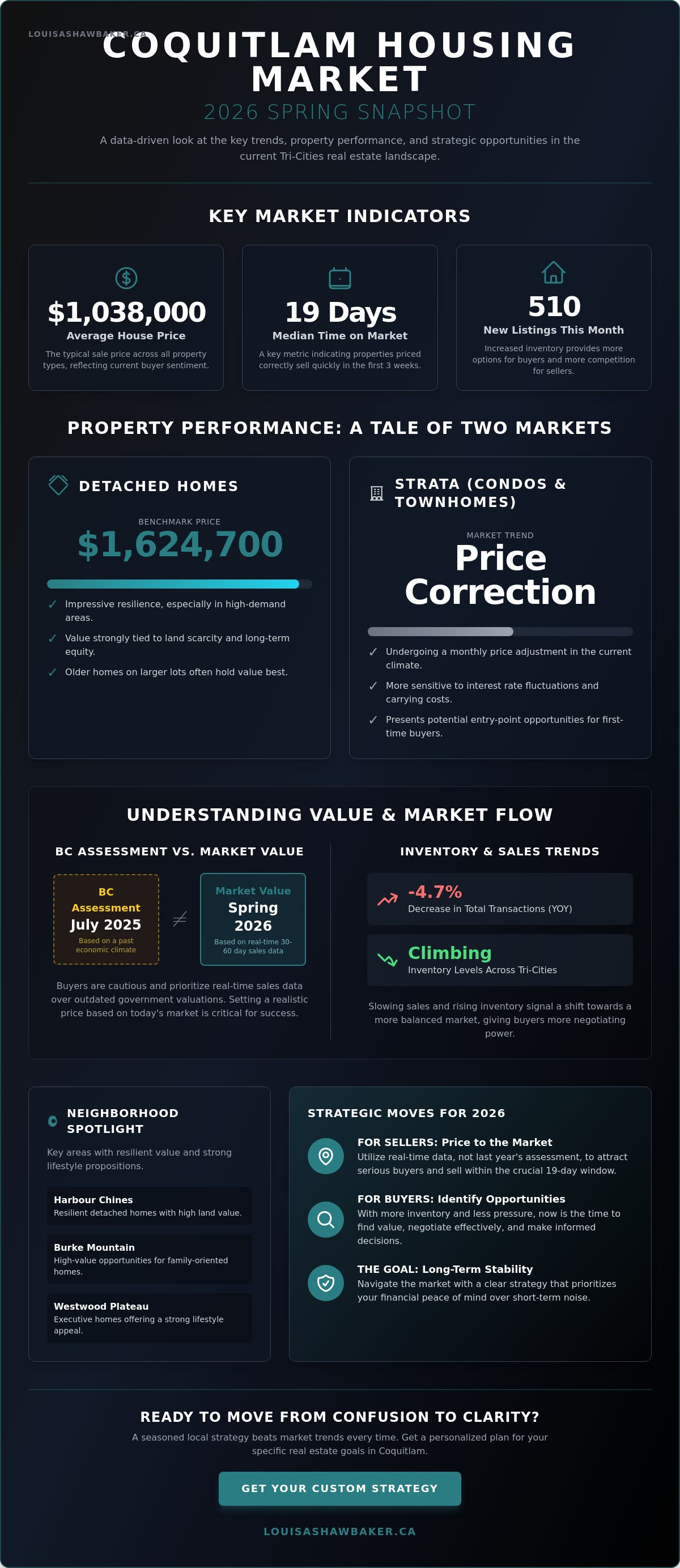
Is the Coquitlam housing market crashing in 2026, or is this actually the most strategic time to move in over a decade? If you're feeling anxious about high interest rates or the gap between your BC Assessment and the $1,038,000 average house price, you aren't alone. Many Tri-Cities residents I speak with are worried about overpaying in a cooling market or seeing their equity shift as inventory grows to 510 new listings this month.
Understanding the Coquitlam housing market trends 2026 is the first step to moving from confusion to clarity. You deserve to know exactly how these shifts affect your specific goals, whether you're looking at a detached home at the $1,624,700 benchmark or a condo in a high-value neighborhood. This guide cuts through the noise to show you where the real opportunities lie. We'll examine the 19-day median time on market and provide a clear strategy for upsizing or downsizing that prioritizes your long-term stability and peace of mind.
Key Takeaways
- Learn why current MLS data provides a more accurate picture than your BC Assessment when evaluating your home's true value in a shifting climate.
- Discover why detached homes in pockets like Harbour Chines remain resilient while Coquitlam condos undergo a monthly price correction.
- Identify high-value opportunities in Burke Mountain and Westwood Plateau where executive homes still offer a strong lifestyle proposition.
- Master the art of "pricing to the market" to ensure your property stands out among the latest Coquitlam housing market trends 2026.
- Understand how a strategic Tri-Cities approach helps you prioritize long-term stability and peace of mind over short-term market noise.
Coquitlam Housing Market Overview: The 2026 Softening Explained
Many homeowners in the Tri-Cities are noticing a distinct shift as we move through the spring season. The Coquitlam housing market trends 2026 show a "softening" that often catches people off guard if they're only looking at broad headlines. While the term might sound concerning, it actually represents a transition toward a more balanced environment. Buyers now have more room to breathe, while sellers must adopt a sharper, data-driven strategy to find success in a competitive landscape.
Currently, the benchmark price for all property types in Coquitlam sits at $998,300. This figure represents the "typical" home in our community, but it doesn't tell the whole story for every specific neighborhood. From the family-oriented streets of Burke Mountain to the established properties in Central Coquitlam, the way this benchmark applies depends heavily on local inventory and current buyer demand. Understanding these nuances is what allows a resident to move from a place of anxiety to one of informed confidence.
To better understand how these shifts are playing out on the ground, watch this helpful market update:
Understanding BC Assessment vs. Market Value
Your July 2025 BC Assessment was based on a different economic climate than what we're seeing in Spring 2026. It's a common point of confusion for many sellers who expect their listing price to mirror an outdated government valuation. In reality, buyers are currently displaying a cautious sentiment. They aren't willing to pay a premium just because a document from last year suggests a certain value. When I work with clients, we prioritize real-time sales data from the last 30 to 60 days to set a realistic expectation. This local insight is crucial because Coquitlam Demographics show a diverse population with varying needs, and those needs dictate what people are actually willing to pay today.
Inventory Trends and Sales-to-Active Ratios
We've observed a 4.7% decrease in total transactions across the Tri-Cities compared to the previous year. This market slowdown means that inventory levels are beginning to climb, giving buyers more options and less pressure to make impulsive decisions. For sellers, "days on market" has become the most important metric to track. If a home isn't seeing significant interest within the first 19 to 21 days, it often indicates that the price or presentation isn't aligned with the current market reality. Staying informed is the best way to navigate these changes, and you can get a deeper look at the specific numbers in this Free Greater Vancouver Market Report.
In 2026, the typical Coquitlam home is defined as a property valued at the $998,300 benchmark, representing a blend of stabilizing detached home prices and slightly corrected strata values across the region.
Detached Homes vs. Strata: Property Type Performance
The performance of different property types is diverging as Coquitlam housing market trends 2026 continue to evolve. We're seeing a clear distinction between the detached sector and strata properties like condos and townhomes. This divergence creates unique opportunities depending on your specific stage in life, whether you're a first-time buyer looking for an entry point or a family needing more square footage. Detached homes operate within a separate ecosystem because their value is tied primarily to land scarcity and long-term equity, whereas strata properties are more sensitive to monthly carrying costs and interest rate fluctuations.
The Detached Market: Luxury and Land Value
In high-demand pockets like Harbour Chines, detached homes have shown impressive resilience. The benchmark price for a detached home in Coquitlam currently hovers in the $1.6M range, reflecting a market that values space and privacy. I've noticed that older homes on larger lots often hold their value better than brand-new builds on cramped parcels. Buyers in the Tri-Cities are increasingly looking for land value and the flexibility that comes with a traditional backyard. According to recent BC Housing Market Data, this segment remains a pillar of stability even when other sectors soften. If you're looking for a long-term family legacy, exploring Coquitlam houses for sale is a great place to start your search.
Condos and Townhomes: The Entry Point Shift
The strata market is experiencing a different rhythm. Coquitlam condos are currently seeing a 3.9% monthly price correction, bringing the apartment benchmark to approximately $664,000. This shift is largely driven by the dual pressure of high interest rates and rising strata fees, which directly impact a buyer's monthly budget. Many buyers are performing a careful balancing act between their mortgage payments and the escalating costs of building insurance and maintenance fees.
Despite these corrections, townhomes remain the preferred "middle ground" for families in Port Coquitlam and Coquitlam who aren't quite ready for a detached mortgage but need more room than a condo provides. We're also seeing a significant number of Tri-Cities downsizers moving into well-managed attached homes to unlock equity while staying in their familiar community. You can browse current listings for Coquitlam apartments for sale to see how these price adjustments are creating new entry points for buyers. If you're unsure how these property-specific shifts affect your equity, it might be helpful to schedule a quick strategy session to review your options.
Neighborhood Spotlight: Where the Value Remains
While the broader Coquitlam housing market trends 2026 suggest a period of adjustment, value isn't disappearing. It's simply concentrating in areas with strong lifestyle anchors. In my 14 years of helping families navigate the Tri-Cities, I've observed that neighborhoods with specific infrastructure weather these cycles with more stability. Official British Columbia Housing Statistics indicate that homeownership remains a primary goal for residents, but buyers in 2026 are more selective about location. They're prioritizing established communities where the "lifestyle return" is immediate.
Central Coquitlam stands out as a prime example of this trend. Its proximity to the SkyTrain and major transit hubs ensures long-term value retention. Properties within walking distance of the Evergreen Extension are maintaining their desirability because they offer a hedge against rising fuel costs and long commutes. I often tell my clients that transit accessibility is one of the most reliable predictors of property resilience in a softening market. It’s a practical consideration that appeals to both young professionals and investors alike.
Burke Mountain and Smiling Creek
Burke Mountain remains a premier choice for families, and the demand here is largely school-driven. Smiling Creek Elementary acts as a magnet, keeping property values steady even when other areas see a dip. Many buyers I work with are specifically looking for the sense of community found in these newer developments. The ongoing investment in infrastructure, such as the growing Burke Mountain Village, provides a necessary counter-balance to the general market cooling. For a deeper look at why this area is so resilient, you can read my guide on Living in Burke Mountain: A Local Guide.
Westwood Plateau and Heritage Mountain
Westwood Plateau offers a distinct executive lifestyle that continues to attract interest. It's the go-to for executive homes on quiet streets with mountain views. However, we're seeing a shift in how people utilize these properties. I’ve noticed a pattern where downsizers are moving from large detached homes on the Plateau into Port Moody apartments for sale to enjoy a more walkable, urban lifestyle. This movement creates a healthy cycle in the Tri-Cities market. It allows growing families to move into executive neighborhoods like Heritage Mountain at price points that were previously out of reach.
The "quiet street" factor is a major driver in 2026. Buyers are looking for seclusion without sacrificing connection. Whether it’s the wooded trails of Heritage Mountain or the manicured streets of the Plateau, these neighborhoods offer a quality of life that transcends temporary market shifts. My role is to help you weigh these lifestyle trade-offs so you can find a home that offers both personal enjoyment and long-term financial stability.
Navigating the 2026 Market: Strategic Moves for Sellers and Buyers
The current environment requires a departure from the "set it and forget it" mentality of previous years. Coquitlam housing market trends 2026 indicate that both buyers and sellers must be more intentional with their decisions. With a 7.6% year-over-year price decrease observed in certain sectors, the leverage has shifted, but success still depends on a clear, local strategy. In a cautious market where every dollar is scrutinized, the necessity of professional negotiation cannot be overstated to protect your equity and ensure a smooth transition.
For Sellers: Positioning Your Property
If you're planning to list, "pricing to the market" is the only viable path forward. Many homeowners feel tempted to price based on what their neighbor's house sold for in 2024, but that approach often leads to a property sitting stagnant while inventory grows. My Selling a House in Tri-Cities: The 2026 Strategic Seller’s Guide outlines how to capture attention in the first 14 days, which is the most critical window in today's high-inventory environment.
Strategic marketing in 2026 isn't just about listing square footage. It's about selling the lifestyle. Buyers want to know about the proximity to the Coquitlam River trails or the ease of getting to the West Coast Express from a home in Port Coquitlam. Professional staging and high-end listing services are no longer optional; they're essential tools to help a buyer visualize their life in your home. This emotional connection often makes the difference between a successful sale and a frustrating price reduction.
For Buyers: Finding the Opportunity
For those looking at Coquitlam houses for sale, the 2026 market offers a rare chance to negotiate from a position of strength. However, this market favors those with a five-year horizon or longer. Real estate in the Tri-Cities is a marathon, not a sprint. Short-term fluctuations matter less when you're focused on long-term stability and building roots in a community like Burke Mountain.
When evaluating strata properties, looking beyond the granite countertops is vital. I help my clients scrutinize strata documents to identify "hidden" trends, such as upcoming maintenance projects or insurance adjustments that could affect future fees. You can find more details on this process in the Houses for Sale in Coquitlam: The 2026 Local Buyer’s Strategic Guide. If you want to discuss how these trends apply to your specific situation, feel free to book a 30-minute strategy call to explore your options.
The Seasoned Local Advantage: Why Strategy Beats Trends
Navigating a market shift requires more than just access to the MLS. It demands a deep understanding of the local rhythm that only comes from years of active involvement in the community. As we look at the Coquitlam housing market trends 2026, it’s clear that a "one size fits all" approach won't yield the results you need. My 14 years of individual experience, backed by a 40-year family legacy in the Tri-Cities, allows me to offer a perspective that goes beyond the current headlines. I prioritize honest, transparent communication because, in a softening market, your peace of mind depends on knowing the truth about your property’s position.
In this climate, the difference between a successful move and a missed opportunity often comes down to the quality of the strategy you employ. I don't believe in high-pressure sales tactics. Instead, I focus on being a steady, reliable partner who understands the nuances of competitive conditions. Whether we are negotiating a purchase in a high-demand pocket or positioning a listing to stand out against 510 other new entries, my goal is to make the process smooth and successful for every client.
Downsizing with Confidence
One of the most active groups in the 2026 market is the downsizing demographic. Many homeowners are finding that now is the perfect time to transition from a large family home in neighborhoods like Westwood Plateau or Harbour Chines into a more manageable luxury condo. This move isn't just about reducing square footage; it’s about unlocking equity and enhancing your lifestyle. Our downsizing consultations focus on strategic planning. We look at the market cycles to determine whether it’s more advantageous for you to sell your detached home first or secure your new apartment in Port Moody or Coquitlam beforehand. You can learn more about our philosophy and track record on our About Us page.
The Tri-Cities Community Connection
My roots in Port Moody, Coquitlam, and Port Coquitlam are the foundation of my business. This isn't just a territory; it’s my home. This connection is why I adopt the "Seasoned Local Guide" philosophy, acting as a strategic partner rather than a service provider. I’ve seen these market shifts before, and I understand that the long-term health of Coquitlam real estate remains incredibly strong. Our community’s natural beauty, transit accessibility, and top-tier schools ensure that demand will always persist, regardless of short-term interest rate fluctuations.
Success in 2026 isn't about following the crowd; it’s about having a clear strategy tailored to your specific goals. I help clients buy and sell by providing the local insight needed to make informed decisions. Let’s work together to turn these market shifts into your next great opportunity. Explore Coquitlam listings or reach out for a consultation to get started today.
Securing Your Future in the Tri-Cities
The current market shift isn't a crisis. It's a return to an environment where local insight and clear strategy matter most. By understanding the Coquitlam housing market trends 2026, you can move from a place of uncertainty to one of calm, informed action. We've seen how specific neighborhoods like Burke Mountain maintain their value through school-driven demand and how the 3.9% correction in condos creates new entry points. Success today requires looking beyond the headlines and focusing on your long-term goals.
I've spent over 14 years helping families in Port Moody, Coquitlam, and Port Coquitlam navigate these cycles. As a Royal LePage Sterling Realty Top Tier agent, I provide the steady reliability you need to negotiate with confidence. Whether you require specialized downsizing consultations or a results-oriented listing strategy, my goal is to ensure your peace of mind. The Tri-Cities remains a vibrant community with enduring value.
Don't let market noise dictate your next move. Let's build a plan that prioritizes your stability and financial health. Contact Louisa Shaw Baker for a Strategic Market Analysis to discuss your unique situation. You deserve a partner who understands the local landscape and puts your interests first.
Frequently Asked Questions
Are home prices in Coquitlam expected to drop further in 2026?
Prices are stabilizing in certain sectors, but we still see downward pressure on detached homes where the sales-to-active ratio is 11%. This reflects the broader Coquitlam housing market trends 2026 where townhomes remain the hottest segment with a 25% ratio. Buyers have more leverage now than in previous years, making it a strategic time for those with a long-term view to enter the market.
What is the benchmark price for a detached home in Coquitlam right now?
The benchmark price for a detached home in Coquitlam is $1,624,700 as of March 2026. This figure represents the typical detached property in our area. While this is down slightly year-over-year, sales activity for detached homes increased by 32.5% in February 2026 compared to the previous year. This shows that buyers are returning to the detached segment as prices become more accessible.
Is 2026 a good year to downsize in the Tri-Cities?
2026 is an excellent year to downsize if you have a clear strategy for your equity. With 510 new listings entering the market in the last 28 days, you have more choices for your next home than we've seen in a decade. Moving from a detached home into a townhome or condo allows you to capitalize on the current $1,007,500 townhouse benchmark while interest in strata living remains steady.
How does the Coquitlam market compare to Port Moody or Port Coquitlam?
Coquitlam remains the central hub of the Tri-Cities, offering more diverse housing types than its neighbors. Port Moody often commands a premium for its waterfront lifestyle and condo density, while Port Coquitlam usually provides more accessible entry points for first-time buyers. Coquitlam’s strength lies in its balance of executive neighborhoods like Westwood Plateau and transit-connected hubs that appeal to a broad demographic of homeowners.
What neighborhoods in Coquitlam are holding their value best?
Neighborhoods with strong lifestyle anchors like Burke Mountain and Harbour Chines are holding their value best. Burke Mountain benefits from new infrastructure and school demand, while Harbour Chines remains a top choice for those seeking larger lots and land value. Properties near the SkyTrain in Central Coquitlam also show resilience due to their consistent appeal to commuters and investors who prioritize long-term walkability and transit access.
Should I buy a condo in Coquitlam or wait for interest rates to change?
Buying a condo now at the $668,300 benchmark offers more selection and less competition than waiting for a potential rate drop. If rates decrease, we typically see a surge in demand that can quickly drive prices back up. It's often better to negotiate a favorable price in today's Coquitlam housing market trends 2026 and look at refinancing options later when the economic climate shifts.
What is the "Sales-to-Active" ratio in Coquitlam for 2026?
The overall sales-to-active listings ratio in Coquitlam is 16.7% for March 2026. This indicates a balanced market, but the story changes by property type. Detached homes are at 11%, suggesting downward pressure on prices, while townhomes sit at 25%, which technically remains a seller’s market. Understanding these specific ratios helps you determine how much negotiation room you have when making an offer or setting a price.
How do BC Assessment values affect my selling price in a soft market?
BC Assessment values are based on market conditions from July 2025 and don't reflect the Spring 2026 reality. In a soft market, buyers use current MLS sales data from the last 30 days to determine what they're willing to pay. Relying solely on your assessment can lead to overpricing, which often results in a property sitting on the market for much longer than the current 19-day median.